

MPR Live / Middle East / Gulf
Iran–US–Israel and Hormuz Live
Follow declared military restraint, actual force movements and economic pressure alongside Gulf export routes, shipping resilience and the wider food-security risks transmitted through energy, fertilizer and transport costs.
Updated: 8 October 2026Earlier reporting retains its date
MPR assessment
Declared restraint changes the immediate timetable, but continuing blockade and financial pressure leave the wider confrontation intact. MPR assesses endurance through usable revenues, forces actually available and trade routes that remain workable under pressure.
8 October US policy statement · 5 October banking warning · earlier dated context
Iran: declared restraint alongside blockade pressure
Last substantive update: 8 October 2026
Trump sets a pre-election limit on renewed strikes · 8 October
President Donald Trump said on 8 October that the United States would not attack Iran before the 3 November congressional elections. Reuters reported that he also said the blockade of Iranian ports would remain in effect and described discussions with Tehran as productive. Reuters report
Washington is signalling a period of restraint on renewed attacks while retaining blockade pressure. That changes the declared near-term timetable and provides a defined period in which to judge the diplomatic effort. The statement alone establishes neither an agreed ceasefire nor a withdrawal of forces. Evidence of implemented military restraint, changes to the blockade or a substantive agreement with Tehran would determine whether this develops into wider de-escalation. For now, the significant change is the president’s stated limit on the timing of US attacks.
Banking pressure · 5 October notice
The US Treasury warned foreign financial institutions on 5 October that continued dealings with sanctioned Iranian banks could bring sanctions without advance notice. The warning reinforces pressure on the financial channels through which Iran conducts international business. It establishes a warning to those institutions; it does not show how many transactions have stopped or quantify a loss of Iranian military capacity.
Financial pressure acts on a different part of military endurance from a strike. The test is whether it disrupts usable revenue, procurement payments or access to supplies. A warning can increase transaction friction without immediately stopping trade; its announcement alone does not measure a reduction in Iran’s combat capability.
The force picture still requires arrivals, departures and available support to be counted separately. The confirmed bomber return and carrier visit below remain dated evidence. Neither the banking notice nor those earlier movements establishes an attack timetable. The next consequential evidence would be a sustained interruption of payments, confirmed changes in forces on station, or an implemented diplomatic arrangement.
Completed departures, not just announced deployments
A US defence official confirmed in reporting published on 4 October that all American bombers deployed to RAF Fairford had returned to US home stations. The official gave no specific reason and said the bomber force could still conduct missions from the continental United States.
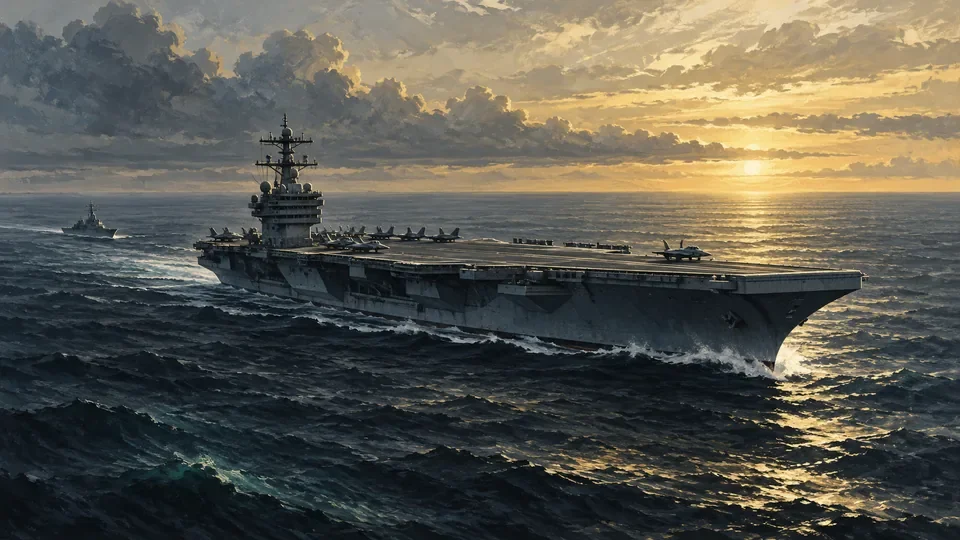
The US Navy separately confirmed that USS George H.W. Bush arrived in Phuket, Thailand, on 4 October for a scheduled visit after supporting Middle East operations. That establishes the carrier’s presence outside the Middle East on that date. It does not establish the total carrier strength remaining in the region.
Count what has left as carefully as what is heading toward the theatre. These developments do not support treating every deployment announcement as cumulative reinforcement. They also do not remove Washington’s strike option: bomber reach survives a return to home stations, while the ability to sustain operations depends on support, availability and the forces actually committed.
The distinction is between capacity for a strike and capacity for a prolonged campaign. The updated record adds completed departures to the earlier outward movements. A net increase in regional combat power has not been demonstrated by this evidence; nor does a departure, by itself, establish a political decision to de-escalate.
Diplomatic reporting · 3 October
Reporting citing three unnamed US officials describes a 2 October Camp David meeting on Iran and Yemen.
Naval background — 27–29 September
USS Theodore Roosevelt left San Diego on 27 September. Its reported mission is a Middle East deployment to relieve USS George Washington. A Navy image caption dates Roosevelt's Pacific flight operations to 29 September. These September records establish an underway carrier and its reported relief role; they do not establish its subsequent arrival near Iran.
Amphibious background — 28 September
Makin Island's amphibious group reportedly departed San Diego on 28 September with the 13th Marine Expeditionary Unit. An amphibious deployment adds a different set of options from a fleet carrier. Departure is not arrival, and the presence of embarked Marines does not establish an order for a landing.
Iranian position — 2 October
In a 2 October statement, the IRGC threatened a stronger response to a future attack or threat. It remains conditional deterrent messaging. The statement does not announce that the threatened operation has begun.
The military test: replacement or reinforcement?
MPR’s assessment on 3 October rated the threat of a wider war involving Iran as very high. That assessment judged the force posture consistent with preparations for an attack; whether the political decision is executed remains a separate question. The useful distinction is between a force able to conduct another strike and one positioned to sustain a broader campaign.
A carrier rotation can preserve existing striking power without increasing it. An overlap becomes more significant if the incoming group remains while the outgoing group stays on station. The amphibious force adds a separate instrument: its presence should be assessed by mission and location, rather than folded into an inflated aircraft-carrier count.
The regional picture also extends beyond Iran itself. Saudi–Houthi fighting and pressure on Red Sea access can create simultaneous demands on air defence, naval protection and allied decision-making. That complicates escalation control even without evidence that Tehran directs every operation. Read the Yemen–Saudi theatre assessment alongside the naval deployment record.
What to watchConfirmed arrivals and departures, sustained changes in forces available for operations, support deployments, operational orders and substantive diplomatic agreements.
September export observations · 2 October UN scenario retained
Hormuz: export resilience and the wider cost of disruption

Last substantive update: 6 October 2026
Export resilience · September observations
Kpler's analysis of 1–28 September estimates that non-Iranian crude and condensate exports from the Gulf reached at least 16.5 million barrels a day, matching its pre-war comparison. About 40% bypassed Hormuz, against 17% before the war. These are September observations, with data assessed as of 29 September. The recovery reflects alternative routes and offshore transfers; it does not establish normal, unrestricted passage through the strait.
Alternative routes can reduce the effect of pressure on a chokepoint while moving the burden to pipelines, loading terminals and vessels. The ability to export physical cargo is distinct from the ability to receive and use its proceeds. The new banking warning concerns Iran; Kpler’s recovery estimate excludes Iran. Those are different economic pressures and must not be treated as one regional recovery measure.
The September figures do not establish present-day safe passage through Hormuz or remove the wider cost scenario below. Track comparable export volumes, available transport and sustained changes in the cost of moving cargo. That evidence would show how much disruption is being absorbed and how much is being passed onward.
Wider cost scenario · retained 2 October reporting
Reporting: 2 October 2026 · Assessment updated: 3 October 2026
At the same UN briefing, UN Women projected that Middle East escalation could leave 11.7 million additional women and girls in 28 countries facing food insecurity by December. It identified disruption around Hormuz and higher energy, fertilizer and transport costs as transmission channels.
A maritime crisis can affect household food access far beyond the region. This is a projected risk, not an observed increase.
MPR assesses that sustained disruption would widen the strategic contest beyond the immediate theatre. Rising input and transport costs can push governments to secure shipments, absorb costs or press for a settlement. That pressure may alter coalition endurance and diplomatic priorities, although different governments could respond in opposing ways.
Watch next: sustained changes in shipping availability and insurance costs; energy or fertilizer pressures carrying into purchasing decisions; and government measures or diplomatic conditions tied to restoring trade. Those indicators would show whether the projected economic strain is beginning to influence state policy.